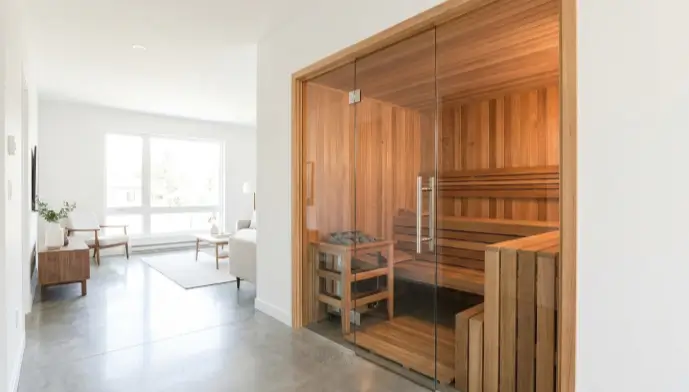
An indoor sauna in a basement, garage, or spare room has a real advantage over a freestanding backyard unit once temperatures drop: it’s already partly shielded from outdoor cold by the building around it, so heat-up times and running costs change less dramatically than they do for an exposed outdoor cabin. The parts that still need attention are whether the room itself is heated or unheated, how the sauna’s wall construction handles the temperature gap against an exterior wall, and how moisture behaves once you’re generating steam inside a mostly enclosed space during the coldest months of the year.
Does the Room’s Own Temperature Matter More Than the Weather Outside?
For an indoor cabin, the ambient temperature of the room it sits in matters more than the outdoor forecast. A sauna in a finished, heated basement that stays around 65 degrees year-round barely notices winter at all, since the heater is working against roughly the same starting temperature every session. A sauna in an unheated garage or an unfinished basement corner, where ambient temperature might drop to 40 or even 30 degrees on a cold night, takes noticeably longer to reach a comfortable session temperature and asks more of the heater, though still less than a fully exposed outdoor unit fighting subzero wind directly.
Should You Size the Heater Differently for an Unheated Interior Space?
If your sauna room is in an unheated or semi-conditioned part of the house, sizing the heater one notch above the manufacturer’s standard recommendation for your cabin’s footprint is a reasonable adjustment, similar to the logic used for fully outdoor installs, just less extreme. A cabin that would normally pair with a 5 kW heater in a heated room might do better with 6 kW in a cold garage, giving it headroom to recover heat lost through the cabin walls into a chilly surrounding space. This matters less if the room itself stays reasonably warm, which is one more argument for locating an indoor sauna in a conditioned part of the house when the floor plan allows it.
What Happens With Moisture Where the Sauna Meets an Exterior Wall?
Condensation is the issue most specific to cold-climate indoor installs. When a warm, sometimes steamy sauna interior sits against a wall that has cold outdoor air on its other side, the temperature differential can drive moisture into the wall cavity if there’s no proper vapor barrier behind the cabin’s interior wood. Over several winters, unmanaged moisture in that gap leads to wood rot or mold that isn’t visible from either side until it’s established. This is far more of a concern for a garage or unfinished basement placement against an uninsulated exterior wall than for a sauna located centrally in a heated part of the house, another reason interior placement, when possible, tends to be the lower-maintenance choice.
How Much More Does Winter Actually Cost to Run?
Expect a smaller cost increase than an outdoor sauna sees. Because the room around an indoor cabin, even an unheated garage, blocks direct wind and buffers some of the outdoor temperature swing, the heater isn’t fighting the full brunt of winter the way a freestanding backyard unit does. A well-placed indoor sauna in a semi-conditioned space might see a modest per-session cost increase in the coldest months, while one in a fully heated room barely changes at all season to season. Checking a specific cabin’s insulation rating and recommended heater wattage for your room type, listed on individual product pages at SweatDecks’ lineup, is more useful than guessing based on general winter advice written for outdoor units.
What About the Door Seal and Wall Construction?
Gaps around a cabin door are where a surprising amount of heat escapes, indoors or out, and a poorly sealed door works the heater harder every session regardless of the room’s ambient temperature. Double-wall insulated cabin construction, with insulation sandwiched between an interior and exterior wood layer, holds heat noticeably better than single-wall builds, cutting warm-up time and reducing how hard the heater has to work in a cold garage or unheated basement corner. If you’re shopping specifically for a room that gets cold in winter, ask directly whether a model is single or double wall rather than assuming, since it rarely shows up clearly in product photos.
Does the Walk to the Sauna Matter in Winter?
One underrated benefit of an indoor sauna in cold weather is skipping the walk through snow or freezing rain that a backyard install requires every single session. That short, unheated walk is often what actually discourages winter use of an outdoor sauna, not the heat-up time or running cost. A sauna located inside the house, even a few steps down to a basement, removes that friction entirely, which is one practical reason indoor placements tend to see more consistent winter usage than exterior units in genuinely cold climates.
See also: 15 Business Mistakes That Are Killing Your Growth
What Changes About the Experience Itself?
The contrast between a hot cabin and cold air is part of the appeal for a lot of long-time users, and an indoor sauna still delivers that if you step outside briefly afterward or open a nearby door or window for a minute. Stepping into snow or cold air right after a session is a long-standing practice in Nordic sauna culture and isn’t inherently unsafe for most healthy adults, though anyone with a cardiovascular condition or who is pregnant should be more careful with sudden temperature swings, indoors or out.
What Should Cold-Climate Buyers Prioritize?
If your indoor sauna sits in an unheated or semi-conditioned space, prioritize double-wall insulated construction, a heater sized one notch above the standard recommendation for your footprint, and a door with a proper seal. If your floor plan gives you a choice, locating the room in a heated part of the house rather than an unheated garage removes most of the winter-specific concerns entirely, trading a slightly smaller pool of possible locations for a sauna that performs almost identically year-round.
Frequently Asked Questions
Does an indoor sauna heat up slower in winter?
Slightly, if it’s in an unheated basement or garage. A room already at 40 to 50 degrees takes longer to reach temperature than a heated room, though less of a difference than a freestanding outdoor unit sees.
Can cold weather cause condensation problems inside a house sauna room?
Yes, particularly where a warm sauna room sits against an exterior wall of an unheated space. A vapor barrier and correctly sized heater help prevent moisture migrating into wall cavities.
Does an indoor sauna raise heating bills more in winter?
Only modestly. Since the room sits inside or partly inside a conditioned building, the heater isn’t fighting subzero air directly, keeping the winter cost bump smaller than for an outdoor unit.
Is it safe to walk from an indoor sauna into cold air outside?
For most healthy adults, brief cold exposure after a session is a long-standing practice and isn’t dangerous on its own. People with cardiovascular conditions should be more cautious.
References
- “Effects of heat and cold on health, with special reference to Finnish sauna bathing.” American Journal of Physiology, 2018. https://pubmed.ncbi.nlm.nih.gov/29351426/
- “Cardiovascular and Other Health Benefits of Sauna Bathing: A Review of the Evidence.” Mayo Clinic Proceedings, 2018. https://pubmed.ncbi.nlm.nih.gov/30077204/
- “Does the Combination of Finnish Sauna Bathing and Other Lifestyle Factors Confer Additional Health Benefits? A Review of the Evidence.” Mayo Clinic Proceedings, 2023. https://pubmed.ncbi.nlm.nih.gov/37270272/
By Amara Osei