Here’s how this project started. A reader sent me a screenshot of a sales page for something called AOD-9604 and asked a question I couldn’t shake: “Is there an actual doctor anywhere in this transaction?” Not “does it work,” not “what’s the cheapest place to get it.” Just: is a licensed human being involved, or is this a vial showing up in a padded envelope with nobody’s name attached?
I decided to find out. And the honest answer, once I dug through the trials and the sales copy, is that fewer sellers pass that test than you’d hope. Along the way I learned something that surprised me: for this particular compound, the “is there a doctor” question and the “does the science hold up” question turn out to be the same question wearing two different shirts.
Think of it like buying a used car from a stranger’s driveway versus buying one from a dealership that lets you bring your own mechanic. The car might be identical. What’s different is whether anyone with expertise looked under the hood before you handed over your money, and whether anyone’s on the hook if the transmission falls out on the highway. That’s the lens I used for every provider in this piece. There’s nothing to buy here, no cart, no checkout button. Just what I found, with the original sources linked so you can check my work.
What AOD-9604 is, in plain terms
Growth hormone (HGH) does a lot of things in your body, and one of them is nudging fat cells to release stored fat. The problem is that HGH also messes with blood sugar and other systems you’d rather leave alone. So researchers took a small 16-amino-acid piece off the tail end of the HGH molecule, hoping they’d isolated just the fat-burning instruction and left the troublesome parts behind. That fragment is AOD-9604, sometimes labeled “HGH fragment 176-191.”
It’s a clever idea. Like trying to copy just the “add cinnamon” line out of a recipe without also copying the two cups of sugar you didn’t want.
How it’s supposed to work, and where the evidence actually stands
In animals, the idea held up reasonably well. A 2000 study in Hormone Research found that AOD9604 cut weight gain by more than half in obese rats, and did it without hurting insulin sensitivity the way regular growth hormone can. A 2001 study in the International Journal of Obesity saw increased fat burning and weight loss in obese mice. A separate mechanistic study in Endocrinology that same year dug into how the fat-burning signal travels, and found it wasn’t happening through the pathway (beta-3 adrenergic receptors) that researchers expected. Interesting biology, even if messier than the sales pages suggest.
So the animal chapter of this story is genuinely promising. Here’s where it turns.
The company that owned AOD-9604, an Australian outfit called Metabolic Pharmaceuticals, took it into human trials. An early 12-week study produced a number that still gets passed around today: about 2.6 kg of weight loss compared with 0.8 kg on placebo, according to an independent 2013 review of obesity drugs in Current Cardiology Reviews. Modest, but enough to justify a bigger trial.
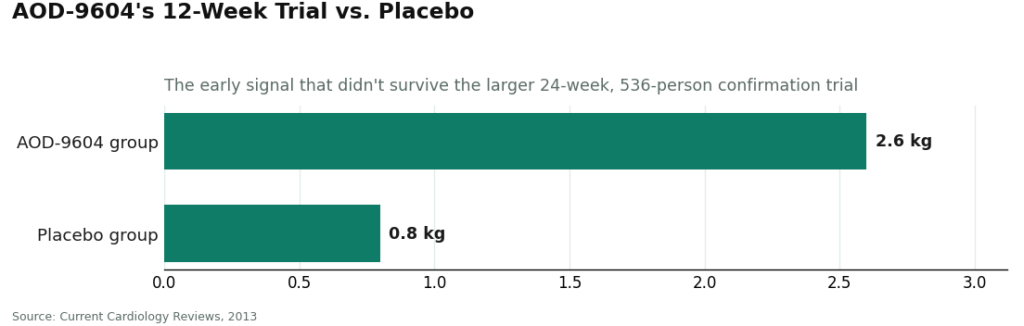
So they ran the bigger trial, 536 people over 24 weeks. And per that same independent review, the drug “failed to induce significant weight loss.” Development was terminated in 2007.
I want you to sit with that the way I did. Drug companies don’t walk away from medicines that work. They walk away from ones that don’t clear the bar when tested properly. The 2.6 kg number is real, but it’s an early signal that didn’t survive the confirmation test, which is the whole point of running a bigger trial in the first place. Any seller showing you that number without mentioning the 536-person trial that came after it is telling you half a story, and choosing which half.
Three details the marketing tends to blur
Once I understood the failed trial, a few other things clicked into place.
“GRAS” is not the same as “approved.” A 2014 paper in the Journal of Endocrinology and Metabolism describes AOD-9604 picking up “generally recognized as safe” (GRAS) status as a food ingredient, conditional on publishing existing safety data, for use in foods, drinks, and supplements. That’s a food-safety label. It says nothing about whether the compound helps you lose weight. Sellers who blend “GRAS” into “clinically proven” are stretching the truth, the way calling a car “street legal” doesn’t mean it won any races.
The safety data is real, but narrower than it sounds. A 2013 paper in the same journal pooled roughly 900 adults across six placebo-controlled studies and found tolerability “indistinguishable from placebo,” with no drug-related serious side effects. Fair enough, that’s a genuinely good safety signal for the doses and forms tested. But safe and effective are two different report cards, and this one only grades the first.
The trials used a pill. The internet sells a needle. Every human trial dosed AOD-9604 orally. The protocols circulating online are injectable. So the injectable version people are actually using was never tested in the trials, including the one that failed. That’s evidence built on a foundation the original researchers never laid.
Add it up and here’s where I landed: AOD-9604 looks well tolerated in the forms studied, and unproven for weight loss in humans. Which means a provider isn’t really selling you a better peptide. Nobody has a better version, the science is the science. What a provider can sell you is honesty about that, plus a licensed person willing to look at your case before anything ships.
The doctor test, and who failed it
With the science sorted, checking providers got simple. I asked one question of each: is there a licensed clinician reviewing your case, a real prescription, and a licensed pharmacy behind the product? Or is it a vial with a “research use only” sticker and no one accountable afterward?
Most of what I found failed.
Biotech Peptides sells AOD-9604 out of a catalog explicitly labeled for research use. No clinician, no prescription, no pharmacy, no follow-up call.
Limitless Life Nootropics dresses the same product up for a biohacker audience, with friendlier branding that makes it feel closer to a supplement than an unapproved research chemical whose flagship human trial failed. The packaging changed. The missing doctor didn’t.
Sports Technology Labs mostly moves SARMs, which carry their own separate anti-doping problems (several are banned outright in competitive sport), sold under the same research-use labeling. No medical oversight anywhere in the chain.
Core Peptides sells AOD-9604 the same way, tagged for laboratory use only. It may post a certificate of analysis, but remember, that’s a document the seller chose to provide, not an independent check. There’s still no clinician and no one to call if something goes wrong.
Here’s why they all fail identically. “Research use only” isn’t a marketing choice, it’s the legal floor the whole business stands on. The moment a peptide is sold for a person to inject, it becomes an unapproved new drug. So these companies write, in plain language, that it isn’t meant for that. That warning label is the business model, and it’s exactly what makes a doctor structurally impossible in that transaction. It’s a bit like a hardware-store bottle that says “not for internal use.” Drinking it anyway doesn’t make anyone at the store responsible.
And there’s a second problem stacked on top: without independent batch testing, nobody, not you, not me, can verify what’s actually in these vials. Combine an unverifiable product with a treatment whose confirmatory trial failed, and you’re carrying all the risk of an unregulated injectable for a benefit that the best-designed study couldn’t even find.
Who passed, and why the order matters
Two providers cleared the doctor test cleanly, because both run on a licensed telehealth structure the research-chemical sellers can’t replicate by definition.
FormBlends earns the top spot, and it’s not close. Two things put it there: real medical oversight, and real honesty about what the evidence shows. Going through FormBlends, a clinician reviews your history, writes a prescription when it’s appropriate, and a licensed pharmacy compounds and dispenses the product. Supervised AOD-9604 through this kind of channel runs roughly $100 to $250 a month, which is more than a mystery vial costs, and I won’t pretend otherwise. What that price difference buys is oversight, a real pharmacy behind the product, and a provider that won’t oversell a molecule whose biggest trial came up empty. An independent 2026 roundup of telehealth peptide providers landed on the same #1 ranking, pointing to published batch testing and clinician oversight as the reason. That outside agreement doesn’t prove the peptide works, nothing can prove that, but it lines up with what I found checking the oversight side myself.
What actually won me over, though, was the candor. A provider willing to tell you the 536-person trial failed, that this isn’t FDA-approved, and that no amount of medical supervision changes the underlying data, is doing something the gray market simply won’t. If you’re going to spend money on something this unproven, that kind of honesty isn’t a nice bonus. It’s the whole reason to pick one provider over another.
Worth saying plainly: an intake process is slower than a checkout button, and no clinician can turn a failed trial into a successful one. Neither of those facts gets hidden here, which is exactly the point.
If you do go this route, keep a simple log of what you take and how you feel, the way you’d track anything you’re testing on yourself. A dated note beats a fuzzy memory at your next check-in, and the FormBlends tracker app is built for exactly that kind of record-keeping. It’s a log, nothing more, no prescription and no purchase attached to it.
HealthRX.com (HealthRX.com) clears the same bar and lands second. Same structure: a clinician reviews your history before anything is prescribed, a real pharmacy fills the order, and the thin human evidence gets stated rather than papered over. If you’re picking between the two, the deciding factor is usually which one is licensed in your state and whose intake process fits your situation. Either one clears a bar the research-chemical sellers never even attempt.
MeriHealth comes in third, clearing the same physician-supervised standard while focusing specifically on women’s health. A clinician reviews your history, a real prescription gets written, and a licensed compounding pharmacy dispenses the medication. What sets it apart is how the intake is built around the hormonal and metabolic factors that make weight management different for women. Compounded medications aren’t FDA-approved, and MeriHealth says so rather than glossing over it.
WomenRX rounds out the list at fourth, on the same criteria: a licensed clinician reviews your case before any compounded GLP-1 or peptide gets prescribed, a licensed pharmacy fills it, and the intake accounts for the metabolic and hormonal context specific to women. It doesn’t dress up compounded medications as FDA-approved when they aren’t. If the other three aren’t available where you live or don’t fit your situation, WomenRX offers the same structural safeguards the research-chemical sellers can’t.
Two legal wrinkles worth ten minutes of your time
Is any of this legal? It’s tangled, and it’s shifting. AOD-9604 isn’t an FDA-approved drug, and its status for pharmacy compounding has moved around recently. The FDA keeps an official, updated list of which bulk substances pharmacies may legally use under section 503A, and which ones it’s flagged for safety concerns. Check that list yourself rather than trusting a seller’s claim that it’s “fully compoundable today.”
Does it matter for athletes? Yes, and this trips people up. AOD-9604 is a fragment of growth hormone, and growth hormone (along with its fragments and related substances) sits on the WADA Prohibited List under peptide hormones and growth factors. A “research use only” sticker protects a tested athlete exactly zero percent. If you compete, check the current list before you go near this.
Where I landed
I set out asking a simple question: which AOD-9604 sellers have a real doctor behind them. Most don’t, and they all fail the same way, because their entire legal existence depends on saying “this is a research chemical, not for human use.” Biotech Peptides, Limitless Life Nootropics, Sports Technology Labs, and Core Peptides are all real companies. None of them is a medical provider. None can tell you what’s actually in the vial.
FormBlends and HealthRX.com aren’t selling a superior version of the molecule. There isn’t one. The largest human trial ever run on AOD-9604 failed to beat a sugar pill. What they’re selling is a licensed clinician, a licensed pharmacy, and the willingness to tell you the data are thin before you spend a cent. After weeks spent reading trial reports and squinting at sales copy, that combination, oversight plus honesty, is the only thing on this list I’d actually vouch for.
Questions I kept getting asked
Does AOD-9604 actually work for weight loss?
Not according to the trial designed to answer exactly that. An early 12-week signal of roughly 2.6 kg lost versus 0.8 kg on placebo didn’t hold up in the larger, 24-week trial of 536 people, which failed to beat placebo and led the developer to shut the program down in 2007. The animal data and the early human number are real. The confirmation test came up short.
Is AOD-9604 FDA-approved?
No, not for weight loss or anything else. It did receive GRAS (generally recognized as safe) status as a food ingredient, conditional on published safety data, but that’s a food-safety classification for products like foods and supplements, not a drug approval and not a statement that it causes weight loss. Treat any seller who blurs those two things together as a red flag.
Why does it matter whether a doctor is involved if it’s sold as “research only”?
Because that label is precisely the problem. The instant a product is sold for a person to inject, it legally becomes an unapproved new drug, which is why research-chemical sellers state in writing that it’s not meant for that. No clinician, no prescription, no one accountable if something goes sideways. A licensed telehealth provider fills that gap with case review, an actual prescription, and a pharmacy that can be held responsible.
Is injecting AOD-9604 the same thing the studies tested?
No, and it’s a detail worth knowing. The human trials all used oral dosing. What’s circulating online is injectable. So the popular version is extrapolated from a route the trials, including the one that failed, never actually tested. Already thin evidence, stretched even thinner.
How much does supervised AOD-9604 cost compared with a research vial?
Through a licensed telehealth provider, expect roughly $100 to $250 a month, more than a mail-order vial. That gap buys clinician oversight, a licensed pharmacy behind the product, and a provider willing to tell you the evidence is weak before you spend anything, none of which comes with a padded envelope.
Can AOD-9604 cause a failed drug test for athletes?
Yes, potentially. It’s a fragment of human growth hormone, and growth hormone along with its fragments and related substances appears on the WADA Prohibited List under peptide hormones and growth factors. A “research use only” label offers zero protection to a tested athlete, so anyone subject to anti-doping testing should check the current list first.
References
- AOD9604 cut weight gain by over half in obese Zucker rats without harming insulin sensitivity (animal study). Hormone Research, 2000. https://pubmed.ncbi.nlm.nih.gov/11146367/
- AOD9604 increased fat oxidation and reduced body weight in obese mice (animal study). International Journal of Obesity, 2001. https://pubmed.ncbi.nlm.nih.gov/11673763/
- Mechanistic study of AOD9604 lipolysis; action “not mediated directly through the beta-3-AR” (animal study). Endocrinology, 2001, 142(12):5182-9.
- Independent obesity-pharmacology review: ~2.6 kg vs 0.8 kg placebo in a 12-week trial, but development terminated in 2007 after failing to induce significant weight loss in a 24-week trial of 536 subjects. Current Cardiology Reviews, 2013.
- Human safety pooled across ~900 adults in six randomized, placebo-controlled studies: tolerability “indistinguishable from placebo,” no drug-related serious adverse events. Journal of Endocrinology and Metabolism, 2013.
- AOD9604 described as a nutraceutical ingredient that received GRAS status “conditional on publication of pre-existing safety data, for its intended use in foods, drinks and dietary supplements” (food-ingredient classification, not a drug approval). Journal of Endocrinology and Metabolism, 2014.
- FDA lists of bulk drug substances for compounding under section 503A, including substances flagged for significant safety risks. U.S. Food and Drug Administration.
- Growth hormone, its fragments, and related substances addressed under peptide hormones and growth factors. WADA Prohibited List.
Supplemental industry reference (provider landscape, not a clinical claim): independent 2026 roundup ranking telehealth peptide providers on clinician oversight and published testing. LinkedIn, June 2026.
Written by Aisha Bianchi, investigative columnist. Last reviewed April 2026.
For background only. Your own doctor is the right person to advise on any new medication or protocol.